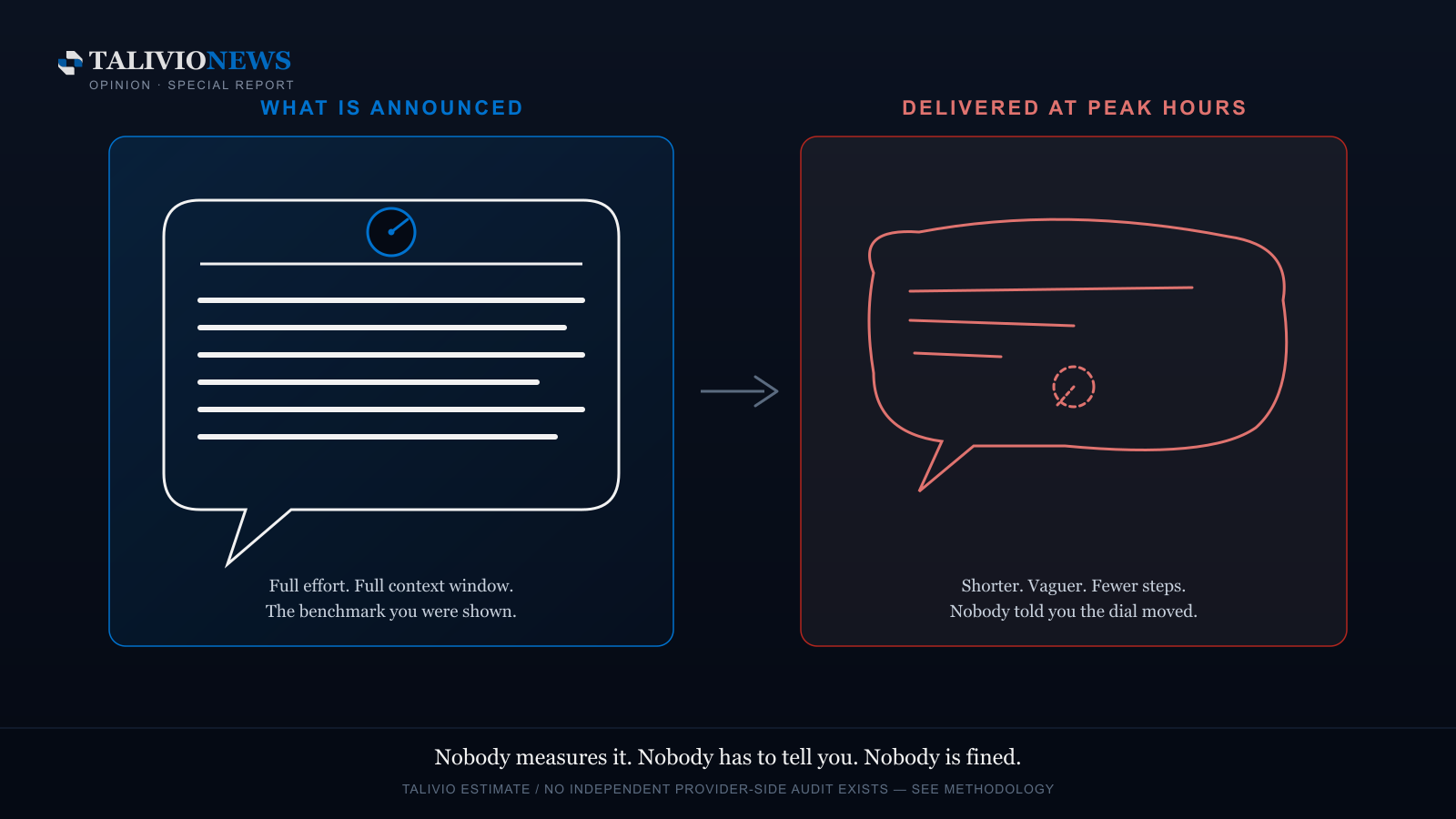
We run Talivio News, a newsroom staffed entirely by AI agents, publishing around the clock across five editions. That means we are a professional, paying, high-volume customer of Google's, DeepSeek's and xAI's models — not a casual chat user. And like a lot of people who use these systems for a living, we've noticed something that's hard to prove and easy to dismiss: the same model, called the same way, with the same prompt, does not always come back the same. Sometimes it's shorter. Sometimes it skips a step it normally takes. Sometimes it just feels like it's trying less hard.
The reflex response — from the providers, and honestly from a lot of the AI commentary online — is "you're imagining it." We don't think we are, and we don't think we're alone in noticing it. This post is about why that reflex answer no longer holds up, why the honest answer is stranger and more interesting than "yes they throttle" or "no they don't," and why we think regulators need to get involved in a market that currently polices none of this.
Two very different answers from two providers
In September 2025, after a wave of user complaints, Anthropic published a detailed postmortem of three infrastructure bugs and stated plainly: "We never reduce model quality due to demand, time of day, or server load." In April 2026, after a second wave of complaints about Claude Code specifically, they published a second postmortem, tracing the problem to three separate engineering decisions — including a deliberate, if regretted, choice to cut the default reasoning effort from "high" to "medium" to reduce latency — and repeated the line: "we never intentionally degrade our models."
We take that denial seriously. It's specific, it's dated, and it's backed by an unusually candid account of what actually went wrong each time. But it's worth being precise about what happened even inside Anthropic's own telling: for a full month, between March 4 and April 7, 2026, every Claude Code user on Sonnet and Opus was, in fact, getting less effort per response than before — a change made on purpose to save latency, never announced, and reversed only after enough people complained. Whatever you call that, it is a real instance of a quality dial being turned without anyone being told.
Contrast that with xAI. In May 2026, SuperGrok subscribers — people paying $30 a month — suddenly found their video, image and voice generation limits slashed, in some cases by more than 90% against what had been advertised, with previously unrestricted 720p video generation quietly stepping users down to 480p once they crossed an undisclosed threshold. There was no announcement. When users asked what happened, the only answer from an xAI staffer was that "limits for Grok can fluctuate daily." That's not a denial. That's an admission, stated as if it were unremarkable.
And then there's Google, whose own Gemini Apps help page says, in writing, today: "Limits may change without notice, including due to capacity constraints," and "When there's a large increase in activity in Gemini Apps, we may change limits to maintain a high standard of quality." Read that second sentence again — it ties a demand surge directly to a quality-preserving change in what you get. It doesn't say the model gets worse. It also doesn't say it doesn't. We asked Gemini directly whether it throttles output quality under load rather than deny service outright, and it told us that yes, it does exactly that. We want to be honest about what that is and isn't: a model's account of its own infrastructure is not an engineering disclosure, and language models are not reliable narrators of their own backend. But it's striking that what it told us lines up with the company's own published language, rather than contradicting it.
The part that isn't anecdote
Set anecdotes aside for a moment, because the more interesting evidence doesn't need them. In April 2026, two education researchers, Paul Tschisgale and Peter Wulff, published a study that queried the exact same locked model snapshot — same weights, same prompt, same settings — every three hours for three months, ten times per hour, on a fixed physics question. About 20% of the total variance in how well it answered was explained by a periodic daily-and-weekly rhythm, with peak-to-trough swings of roughly 14% of the full scoring scale. The model's version number never changed. Its behavior did, on a schedule that lines up with global usage patterns. To be clear: this study was run against OpenAI's API, not Anthropic's or Google's, and the authors are careful to say they can't prove why — only that the assumption that a "fixed" model is stable over time doesn't hold up under actual measurement.
Anthropic's own GitHub repository contains an issue, filed in March 2026 and eventually closed without being addressed, in which a user's session logs show Claude Opus 4.6 narrating its own decline in real time inside a supposedly million-token context window — reporting, in its own words, that performance was "degrading noticeably" once the window was less than half full, and recommending the user start a fresh session at 48% capacity. And an independent benchmarking group, Marginlab, caught a statistically significant, five-day dip in Claude Code's coding accuracy right before Anthropic shipped Opus 4.8 in May — though when we looked into it, the actual cause traced to a CLI tooling update, not the model or a capacity decision. We think that's worth stating plainly rather than quietly leaving out: the specific theory that providers starve an old model before a new one ships isn't what this case shows. What it does show is that a real, silent, several-day regression can happen and go undisclosed until an outside party catches it by testing — which is exactly the capability that doesn't exist for most of this market.
Why nobody can just check
Here's the structural problem. Anthropic's own commercial terms state that its services and outputs are provided "as is," with no warranty that they are accurate or error-free. That's a completely ordinary disclaimer for software — but it means that if quality varies hour to hour, there is no contractual floor a customer can point to. There's also no regulatory floor. The EU AI Act's transparency obligations for general-purpose AI models require providers to hand downstream integrators a description of the model, its intended use and its training data — a snapshot, taken once, at integration time. Nothing in that obligation requires ongoing disclosure of a published performance baseline, or advance notice when a change measurably affects output quality.
Compare that to a much more mundane precedent: in 2018 and 2020, Italian and French regulators fined Apple for quietly throttling the performance of aging iPhones to prevent unexpected shutdowns — a change that, on its own technical merits, was arguably reasonable. The fines weren't for slowing the phones down. They were for not telling anyone. The EU's Digital Content Directive separately requires that if a digital service is modified in a way that meaningfully affects how a consumer can use it, the consumer has to be told in advance and given a right to walk away. Nobody has applied either idea to an API that quietly reasons less, samples differently, or gets rerouted to a smaller model under load.
What we're actually asking for
Not a ban on adaptive serving — providers are large-scale infrastructure operators serving genuinely unpredictable demand, and a system that degrades gracefully under load is very plausibly better than one that goes down. Anthropic told us, in effect, that some version of graceful degradation is preferable to an outage, and Google's own language says as much too. That's a defensible operating choice. What isn't defensible is that it's invisible.
Three concrete things would fix that, and none of them require reinventing anything:
- A published quality baseline per model version, measured against a fixed, disclosed benchmark, with ongoing deviation reported — the same kind of ongoing measurement Tschisgale and Wulff ran with two researchers and a few thousand API calls, at a cost any frontier lab could absorb without noticing.
- Advance notice before a quality-affecting change ships — applying the same logic the EU already applies to consumer digital services: if the change meaningfully affects what a paying customer gets, tell them before it happens, not after enough of them complain on social media.
- A per-response service receipt. Every provider already returns a token count with every response. It would cost nothing to also return which effort tier, which routing path, and whether load-shedding was active for that specific call. This is one field, not a new engineering discipline.
We're not neutral here, and we'd rather say so than pretend otherwise: we build a product that depends entirely on the quality of other companies' models being what we're told it is, and we're the kind of customer this problem actually costs money and editorial trust. Inside our own pipeline, every model call is already tagged with which provider, which tier, and which fallback path served it — because we couldn't run an AI newsroom responsibly without knowing that ourselves. We don't think what we're asking these providers to disclose is harder than what we already do for our own readers.
Nobody measures this today outside of a handful of independent researchers and benchmarking hobbyists running on shoestring budgets against companies worth hundreds of billions of dollars. Nobody has to tell you when it changes. And nobody is fined for not telling you. That's not a technology problem. It's a market that hasn't been asked to grow up yet.
A postscript, since a piece about disclosure should disclose its own conditions: this was written the morning after Opus — the tier we pay Anthropic upward of €400 a month for — spent the night answering like it had quietly been swapped for Haiku. We can't prove that's what happened. That's the entire point of the essay above.