Every design office and workshop has its own way of building. The gap you leave behind a removable panel, the hardware you always use, how thick your walls are, which part goes in first. Most of that lives in the heads of two or three experienced people, and every new job means explaining it again.
Zanatio is a generative AI expert for design and production work: architecture, interiors, furniture, boats, whatever you draw. You teach it how you build once. After that it plans the job, uses the drawing tools, checks the result and hands you a package ready for production. You can give it jobs as you would an employee, or put it next to your designers.
It plans; the tools draw
The easiest way to get AI design wrong is to let the model draw. A language model that invents coordinates will sooner or later put a shelf through a wall. Zanatio never draws by guessing.
- Plans, not pictures. When you say "move the shelves forward" or "add a door to this wall", the AI picks a recipe, library entries and values from numbered lists. That plan goes to rule-based tools, which do the drawing the same way every time.
- Checked before you see it. Your checks run on every proposal: clashes, clearances, fit allowances, whether every part can be taken out again. A warning comes with the rule it breaks. A wrong plan fails validation here, not in the workshop.
- A person approves. The expert prepares the draft and you decide. Nothing is applied until you press Apply, and it comes back as one undo step.
Teach it once, like an apprentice
Give Zanatio one finished example and the rough starting point. It measures how you build — dimensions, gaps, materials, hardware, how the parts go together — and writes your rules down, each with who taught it and when, so the expert can explain its choices. Your materials and hardware become libraries, with every value marked as an example, a rule or an assumption. Your rules stay yours.
Three ways to put it to work
- Assistant, inside the program. Every designer gets an expert at their side in Rhino or SketchUp. Say what to change; the plan is built with your recipes and checked before anything is drawn. It answers in English, Turkish or Estonian.
- Agent, a worker you give jobs to. Upload the rough model and say what you need. The agent works with your recipes and rules, asks when something is unclear, and brings back a package: the model, sections, a cutting list and a README with the assembly notes. The Agent is in a pilot with one workshop today; new workshops can join the waiting list.
- Team, for a workshop. Several named experts, shared points, and roles for designers, the workshop floor and accounting.
Why the first recipes are cabinets
Zanatio is not a furniture product. We started development on furniture detail because that is where a pilot workshop already had real jobs, hand-built references to compare against and rules nobody had written down. Cabinets and beds were the first recipes, followed by boxes, dividers, modules, plinths, frames and wall modules.
That gave us one measured result we can show: on a job from the pilot workshop, a Zanatio proposal reproduced the hand-built reference with 52 of 52 parts identical. It is one example, not a promise for every job. Our first pilot users design yacht interiors in Rhino and buildings in SketchUp, with the same engine and the same way of working. Fields we have not covered yet are coming, and we will publish measured results when we have them.
Inside Rhino and SketchUp
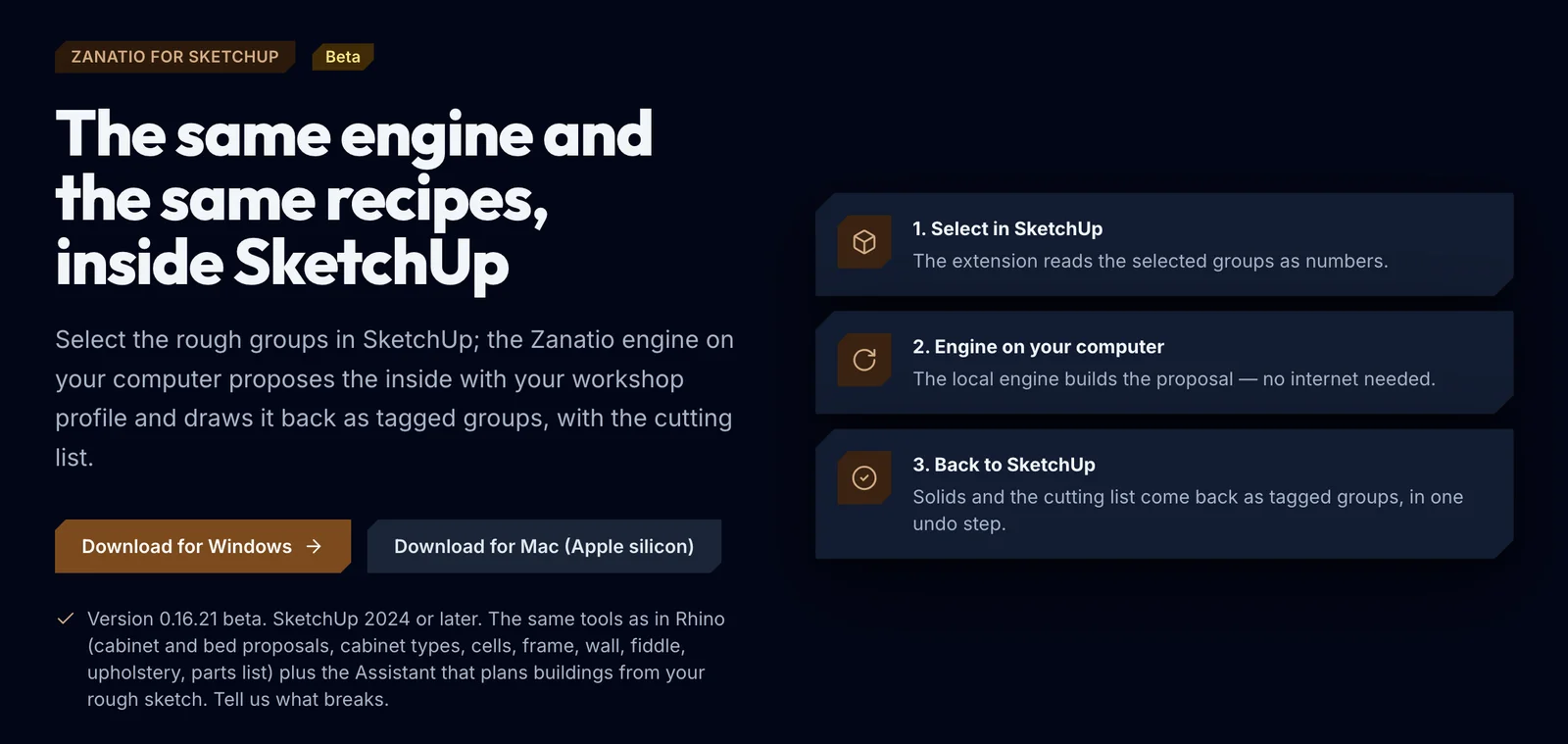
- Rhino 8 on Windows: available now.
- SketchUp 2024 or later on Windows and on Mac with Apple silicon: in beta, with the same tools as Rhino. It is in beta because real users have only just started working with it.
- Revit: coming soon.
One licence follows your Talivio account across Rhino and SketchUp. Signing in to the plugin is a short code confirmed in your browser; there is no password in the plugin. Outputs use fixed layer names in every file: cutting lists, DXF for nesting and PDF sections.
Your file stays on your computer
The engine runs on your computer, and recipes and checks work without an internet connection. When the Assistant plans, only operation names, library names and numbers are sent. No client names, no file paths and no model file.
Pricing
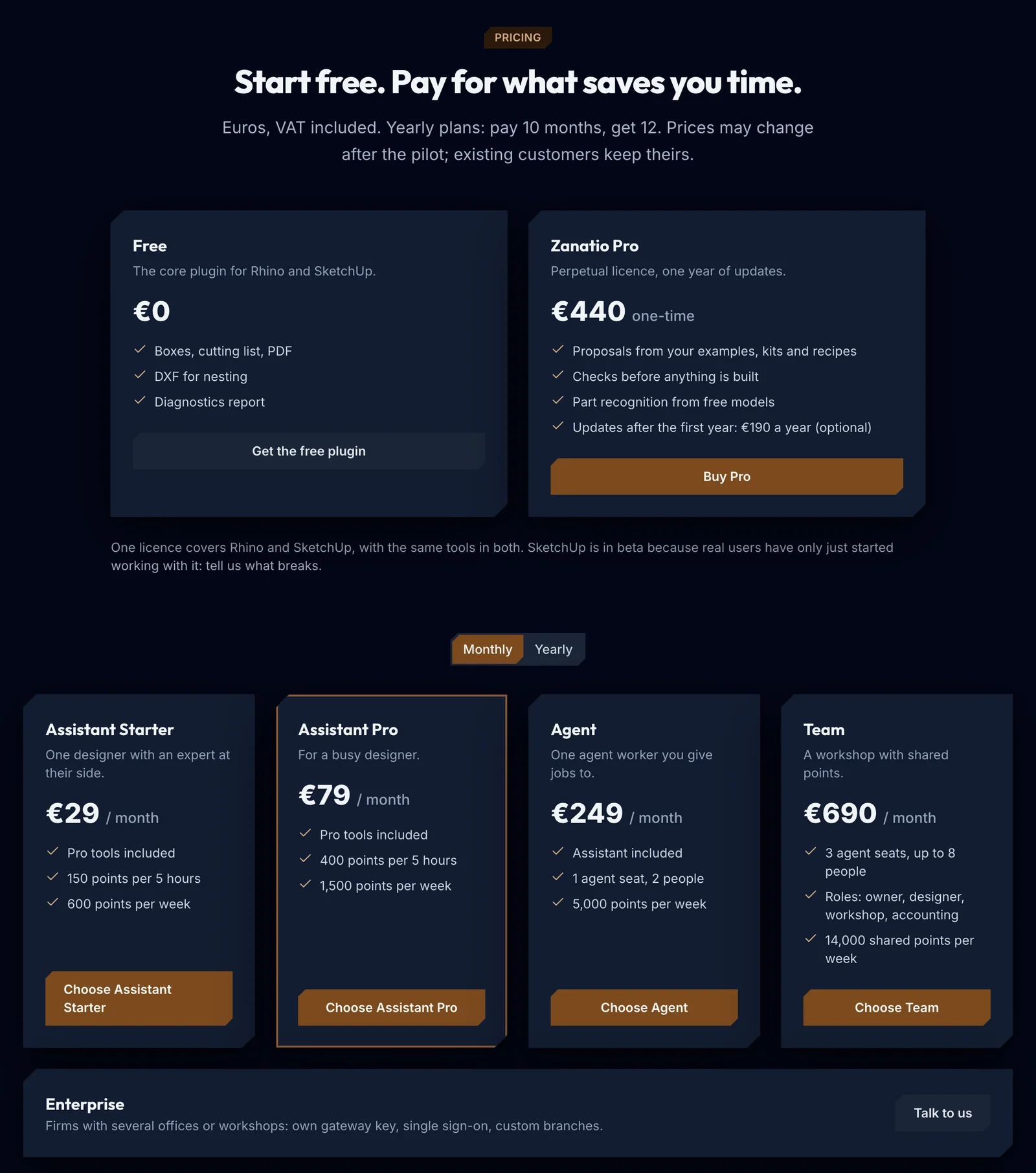
- Free — €0. The core plugin for Rhino and SketchUp: boxes, cutting list, PDF, DXF for nesting and a diagnostics report.
- Zanatio Pro — €440 once. A perpetual licence with a year of updates: proposals from your examples, kits and recipes, and checks before anything is built. Updates after the first year are optional, €190 a year.
- Assistant — from €29 a month. Pro included; usage is counted in points, with a 5-hour window and a weekly allowance.
- Agent — €249 a month, one agent worker for two people, and Team — €690 a month for a workshop with three agent seats.
Prices are in euro with VAT included; yearly plans cost ten months. Extra usage is off until the owner turns it on. Prices may change after the pilot; existing customers keep theirs.
Zanatio and Constructio
Talivio also builds Constructio, a separate tool for quantities, cost and the work plan of a building from its IFC model. The two are sold independently and neither needs the other.
Try it
Create a free account with your Talivio account, install the plugin for Rhino or SketchUp, and give it a job you have already built by hand. Then tell us where its proposal differs from what you would have done. That is exactly what it learns from.